Decide whether to license an asset, and how
Sleuth maps the rivals it will launch against, works out who’s left to treat by your forecast year, benchmarks its data cohort by cohort, and forecasts sales, so you can set the terms.
Free to try on the asset on your desk
What the asset will face, how its data compares, and what it’s worth
Who will it launch against?
Every rival program in the indication, from Phase 1 to approved, counted once and ordered by stage, so you see where the asset would land in line.
Who’s left to treat by launch?
The standard of care today and in your forecast year, with each trial, label, and guideline change dated, and the share of patients still eligible for the asset.
Does its data beat theirs?
Efficacy, durability, and safety compared cohort by cohort, with every comparison that isn’t like for like flagged.
What’s it worth, and what should we offer?
A sales forecast built input by input, the inputs that move it most, and a recommendation on whether and how to license.
Describe the asset, and Sleuth builds the assessment
Describe the asset
Name the asset, the patients it’s for, what its data shows so far, and the decision you face, such as licensing its U.S. rights.
Decide what counts
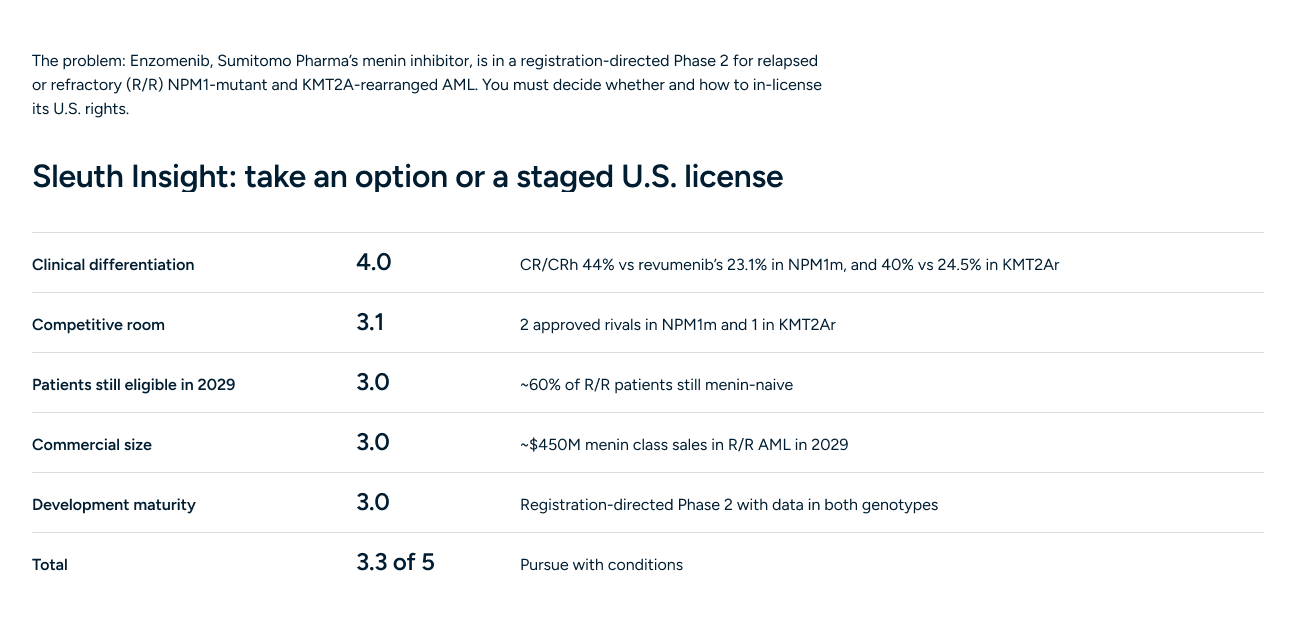
Choose how to score the asset: clinical differentiation, competitive room, patients still eligible, commercial size, and development maturity, and how much each one counts.
Shape the plan
See the four steps Sleuth will run: profile the asset and its rivals, map the standard of care in your forecast year, benchmark the data, and forecast and score. Change the forecast year before it runs.
Get the analysis
A score and a recommendation, the forecast with every input laid out, and the landscape and benchmarks as datasets.
Should you license enzomenib’s U.S. rights? Sleuth says pursue, with conditions.
Sumitomo Pharma’s menin inhibitor in relapsed AML, set against every other menin inhibitor in the clinic. Time on drug moves its 2029 sales most.
Asset Assessment: enzomenib in R/R AML
How a top-10 pharma checked a partner’s asking price
A partner wanted nearly twice what comparable deals had paid for a Phase 2 asset. Studio priced the ask against every comparable licensing deal and each drug’s projected launch order, and BD countered with terms anchored on deals for drugs that reached market first.
Questions
Yes. Every forecast input is laid out with its source and range, so you can put in your own price, share, or time on therapy and see what changes.
Sleuth flags each comparison that isn’t like for like, such as pooled doses, a different patient mix, or a combination regimen, beside the number.
Yes. They’re in the competitive set and marked, as three of enzomenib’s are.
To the forecast year you choose. The example forecasts U.S. sales in 2029.
Yes. The recommendation turns the forecast into terms, such as how large the upfront should be and which conditions to set before exercising an option.
Yes. The same steps work on your own asset, for a partnering story or a portfolio review.