Find out why drugs like yours failed
For every drug like yours that was discontinued, Sleuth works out why it ended and whether your design fixes that failure, so you know where to take your program next.
Free to try on your own program
What ended the drugs before yours, and whether yours avoids it
Which drugs like ours were discontinued?
Every drug like yours that entered the clinic, each counted once with its status checked, and for each discontinued one, the stage it reached.
Why did each one end?
One main cause for each, from the sponsor’s statement or its last reported data, so failures on a drug’s own data stay apart from portfolio and financing decisions.
Does our design fix that failure?
Each option you’re weighing, set against how its drugs failed and marked as fixing that failure or exposed to it, with what your first trial would have to show.
Describe your program, and Sleuth builds its graveyard
Describe your program
Say what your program or platform does, the decision you face, and the options you’re weighing, such as which organ, indication, or target to go after next.
Decide what counts
Choose how to weigh each option: how often its drugs failed on their own data, whether your design fixes that failure, and how early a first trial could show it.
Shape the plan
See the three steps Sleuth will run: find every discontinued drug like yours, find out why each one ended, and compare them with yours. Widen what counts as like yours before it runs.
Get the analysis
A priority for each option, what your first trial has to show, and a table of every discontinued drug with its cause.
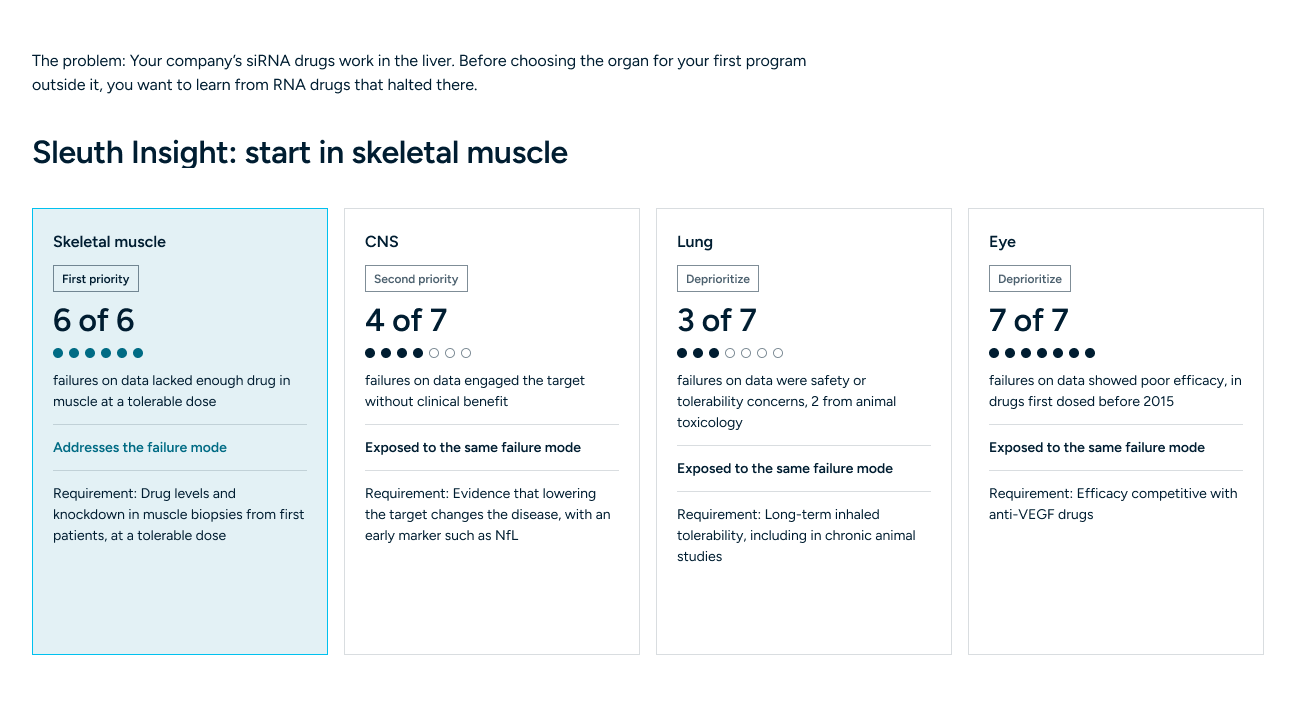
Where should a liver siRNA company go next? Sleuth says skeletal muscle.
233 discontinued RNA drugs, sorted by organ and cause. Every muscle failure on data was a delivery shortfall, the problem it already solves in the liver.
Graveyard Analysis: RNA therapeutics
How past liver-safety failures helped DART-Met weigh where to start
Sleuth mapped ten years of liver-safety setbacks for a Stanford researcher. Only 2 of 25 were in oncology, and most surfaced late, so MASH trial screening stood out as a promising place to start.
Questions
Where the sponsor gave one, Sleuth uses it. Where it didn’t, Sleuth infers the cause from the last reported data and labels it inferred.
Yes. Each drug gets one main cause, so a portfolio or financing decision stays apart from a failure on the drug’s own data. In the example, portfolio decisions were the most common single cause.
Yes. The options can be indications, organs, targets, modalities, or assets you’d license in.
Yes. Sleuth compares your program with the drugs still in development too, so you can see who’s already working on the failure you’d fix.
For each option, Sleuth states the requirement. In the example, that’s drug levels and knockdown in muscle biopsies from the first patients, at a tolerable dose.