Choose the lead indication for your platform
Sleuth checks each disease your platform could treat for proof your mechanism helps, maps who’s already there, and sizes the patients, so you can lead where you’d be first.
Free to try on your own platform
Where your mechanism works, who’s already there, and where to lead
Does our mechanism work in this disease?
Every disease your platform could treat, tested for human proof that your mechanism helps and for a fit with how you’d dose it. A failed trial counts against a disease. Sleuth records why it ruled out each one.
Who’s already there, and how close are they to us?
Every program in each shortlisted disease, from preclinical to approved, sorted by how close its mechanism comes to yours, so you can see where you’d be the first of your kind.
How many patients, and what are they worth?
The patients each position would serve in your markets, and what they’re worth at branded prices against what’s spent on them today.
Where should we lead, and what must the first trial show?
A recommendation on the lead, the second, and the ones to drop, with what your first trial has to show in each.
Describe your platform, and Sleuth finds where to lead
Describe your platform
Say how your platform works, what sets it apart, the decision you face, and any diseases you’re already weighing. Add your deck if you have one.
Decide what counts
Choose what matters most, such as clinical validation, unmet need, competitive room, and fit with your platform, and how much each one counts.
Shape the plan
See the three steps Sleuth will run: test every candidate disease, map the competition, and size each position. Add a disease or drop one before it runs.
Get the analysis
A recommendation on where to lead, with the evidence behind every disease, and the datasets to keep working in.
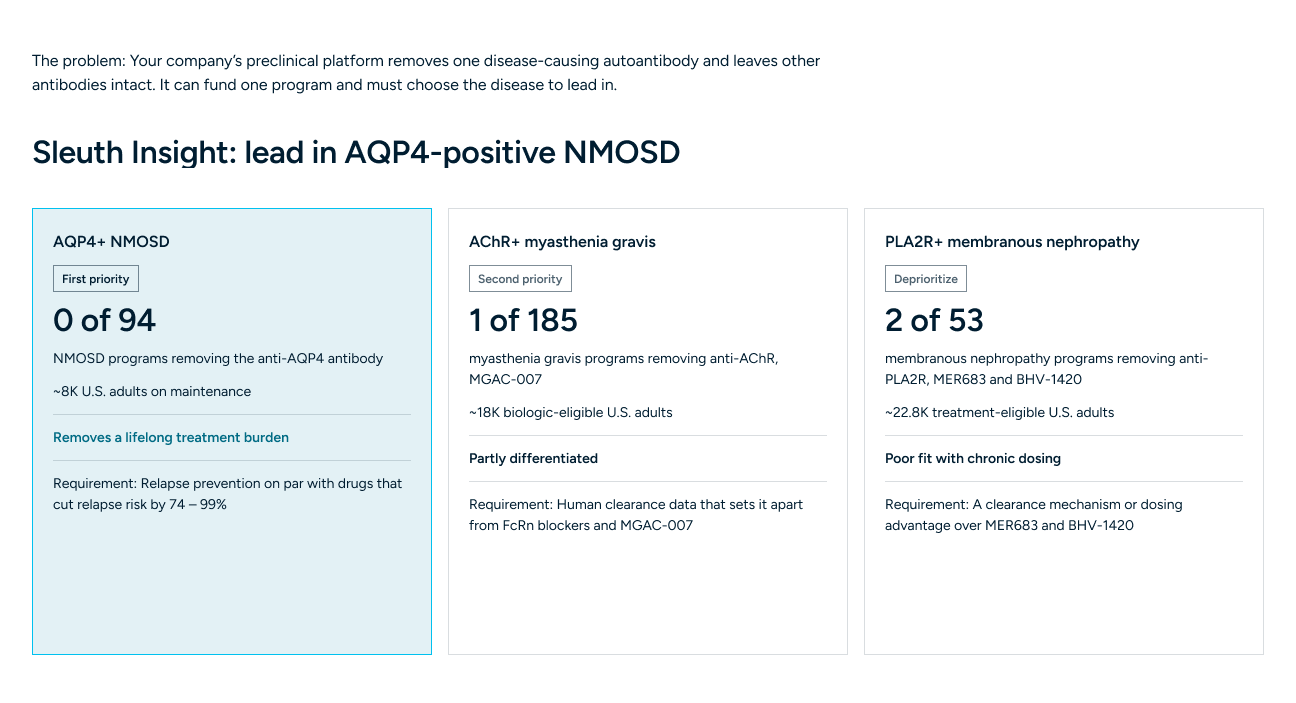
Where should an antibody-removal platform lead? Sleuth says AQP4-positive NMOSD.
Sleuth tested 9 candidate diseases, shortlisted 3, and found that none of NMOSD’s 94 programs removes the antibody that causes it.
Indication Selection: autoantibody remover
How Epana Bio screened 167 indications to choose its lead
A nine-person biotech screened 167 autoimmune indications in Studio, carried 25 into deeper evaluation, and shortlisted 4 on its own criteria. When its board pushed back, the team refined the work in place instead of starting over.
Questions
Yes. Describe the asset the way you’d describe a platform, and Sleuth tests every disease it could treat in the same way.
Add them in step 1. Sleuth tests them alongside every other candidate, so you can see how your list compares.
Sleuth lists the test each one missed and the reason, such as no single antibody that causes the disease, or a removal trial that missed its endpoint.
Every disease your platform could treat in the areas you name, not only the ones on your list. In the example, Sleuth tested 9 candidates and shortlisted 3.
Yes. For each shortlisted disease, Sleuth sizes the patients in your markets and what they’d be worth at branded prices, next to what’s spent on them today.
Yes. Change a weight, and Sleuth ranks the diseases again.